

Stop Wasting Your Crypto Marketing Budget on TikTok (Seriously, Stop)
The platform is actively working against you, and the agencies selling you TikTok playbooks know it.

I’ve been watching my feed fill up with posts from web3 marketing agencies promoting TikTok as the next big distribution channel for crypto projects. And I need to say something because nobody else seems willing to.
TikTok does not work for crypto. And the people telling you it does are either lying to you or trying to sell you a retainer.
I get it - InfoFi just died a spectacular death, and suddenly every agency that built their entire playbook around Kaito Yaps and mindshare farming is scrambling for a new narrative. They need something to pitch to founders. They need a new “channel” to justify their fees. And TikTok with its billion+ monthly active users and that sweet, sweet Gen Z attention sounds so good on a pitch deck.
But here’s the thing: TikTok has been actively hostile toward crypto content for years. And that hasn’t changed.
The platform literally bans crypto branded content
Let me start with the obvious, because apparently it needs repeating.
Back in July 2021, TikTok updated its branded content policy to globally prohibit the promotion of financial services and products. That includes cryptocurrency, trading platforms, foreign exchange, and - I love this one - “get-rich-quick schemes.” All of it. Banned. Globally.
This policy specifically targets branded content, meaning any creator who gets paid by a crypto project to promote it on TikTok is violating the platform’s terms. CNBC spoke with 11 cryptocurrency creators at the time, and they all reported the same thing: videos getting flagged, content taken down, accounts temporarily banned. Some creators said if they got one more video removed, they’d be kicked off the platform entirely.
Now, TikTok does have a beta program for crypto ads in the US and Canada that allows licensed exchanges and custodial wallets to run paid advertisements but that’s TikTok’s own ad system, not creator content. And it comes with a laundry list of requirements: you need proper licensing, you can only target users 18+, and you need explicit regulatory authorization in most jurisdictions. In many countries like Vietnam, Iran and Egypt crypto advertising is banned outright.
So when an agency tells you “TikTok is great for crypto,” ask them: great for what, exactly? Because the moment you pay a creator to shill your token, you’re playing a game you’ve already lost.
Shadow banning: the silent killer of your “TikTok strategy”
Here’s where things get really fun.
TikTok doesn’t officially acknowledge shadow banning. They call it “content ineligibility”, which is a very polite way of saying your video exists but nobody will ever see it. Your content stays on your profile, you can still post, like, and comment. But TikTok’s algorithm simply stops distributing your videos to new audiences. No notification. No explanation. Just... crickets.
And crypto content is one of the categories most susceptible to this treatment.
The platform uses AI-driven moderation combined with human review to flag content that touches on financial services, investment advice, or anything that could be classified as misleading financial information. Even educational crypto content routinely gets caught in these filters. Creators report videos about basic blockchain concepts getting flagged for “promoting illegal activities and regulated goods.”
The typical shadow ban lasts two to four weeks, but for creators who consistently post about crypto, it can become a recurring nightmare. Post a few videos about token analysis, get shadow banned for two weeks. Come back, post more crypto content, get shadow banned again. It’s a cycle that makes any consistent content strategy essentially impossible.
And here’s the kicker - TikTok won’t tell you any of this is happening. You’ll just notice your views dropping from thousands to double or triple digits overnight. Your “For You” page (FYP) traffic goes to zero. Your hashtags stop working. You’re posting into a void and the only way to confirm it is by checking your analytics or asking a friend who doesn’t follow you to search for your content.
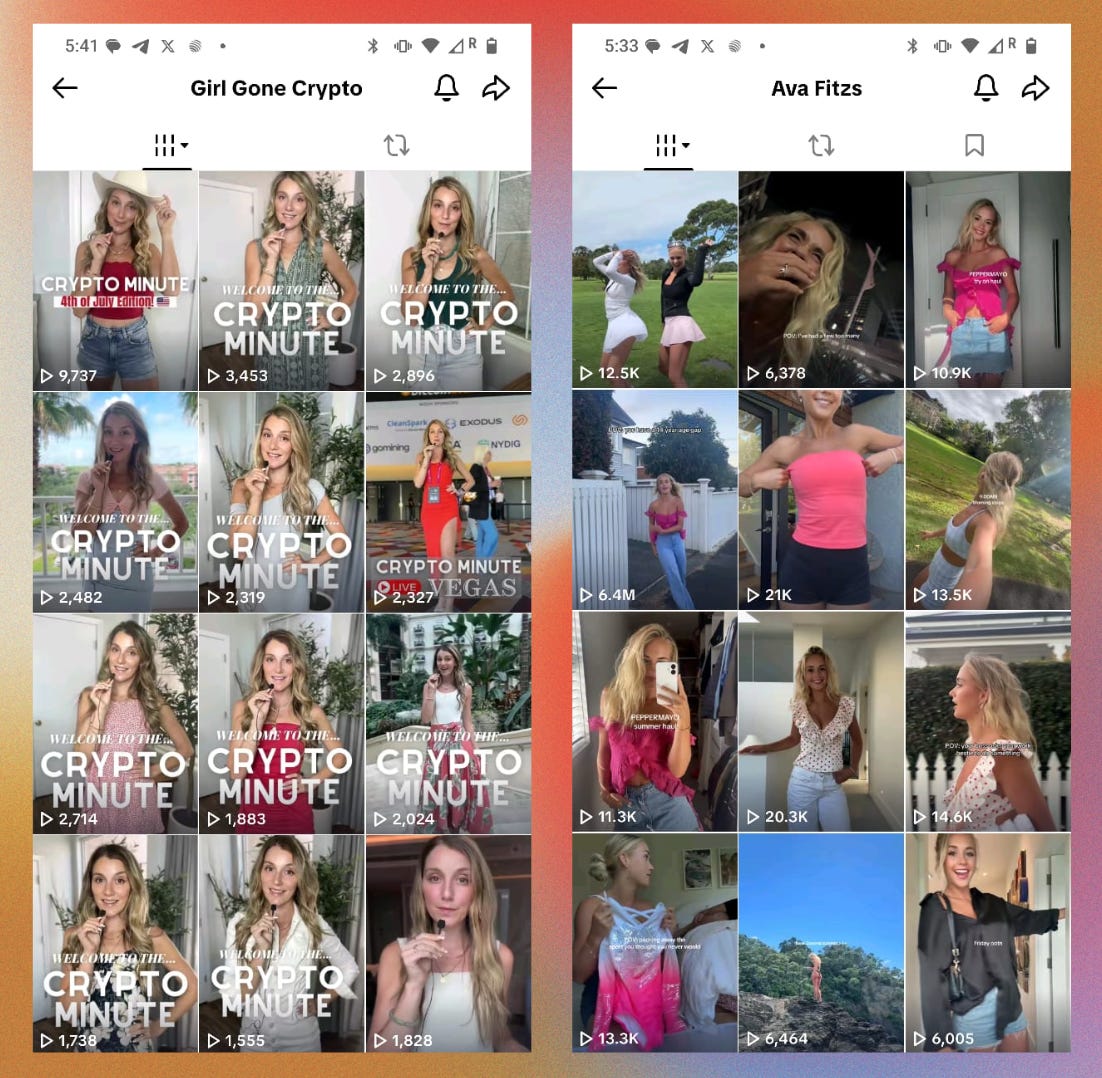
For a crypto project spending $5K-$20K a month on a TikTok creator campaign, this is catastrophic. Your content can be invisible for weeks at a time and you won’t even know until you check the analytics yourself. Good luck explaining that ROI to your investors.
“But some crypto accounts get millions of views!”
Yes. Some do. Occasionally. And that’s exactly the trap.
A crypto creator might have a video blow up to 500K views because it hit the right trend at the right time. Then their next 20 videos get 300 views each because the algorithm decided to limit their reach again. This inconsistency is not a bug, it’s how TikTok works for any content category that sits in a policy grey zone.
Compare this to Twitter, where crypto content is not only tolerated but actively thriving. Or YouTube, where creators like Coin Bureau have built massive, consistent audiences with deep engagement. Or even Instagram where crypto content is generally frowned upon but often manages to slip through the algo and get the views.
On those platforms, your content reaches your audience predictably. You can build funnels. You can track attribution. You can actually measure whether your marketing spend is working.
On TikTok, you’re essentially gambling. Sometimes you win. Mostly you don’t. And you can never predict which one it’ll be.
The real reason agencies are pushing TikTok
I don’t work for an agency so I can’t claim this for sure but here’s my working theory.
The InfoFi collapse left a lot of web3 marketing agencies without a playbook. For over a year, many of them had built their entire service offering around yap-to-earn campaigns, mindshare farming on X, and Kaito Yaps optimization. When X pulled the plug in January 2026, those agencies lost their core product overnight.
Now they need something new to sell. TikTok sounds exciting. It sounds innovative. It sounds like the kind of thing a founder would get excited about in a pitch meeting. “We’ll get you in front of Gen Z! We’ll make your protocol go viral! TikTok is the biggest social platform in the world!”
All true. Also all irrelevant if the platform actively suppresses your content.
The agencies pushing TikTok playbooks right now are, in many cases, the same ones that were selling InfoFi campaigns three months ago. Their incentive is to find the next shiny thing to package into a retainer, and not to tell you the truth about platform dynamics. To no surprise, no single agency has produced receipts to back up their claims of TT success.
So where should you actually spend your marketing budget?
If you’re a crypto project looking for distribution in 2026, here’s my honest take:
X remains the center of gravity for crypto. Yes, InfoFi is dead. Good riddance. But organic crypto conversation on X is thriving. Build real thought leadership, engage authentically, and work with KOLs who have genuine influence (not just follower counts and other vanity metrics).
YouTube is unmatched for long-form trust building. The crypto creators with the deepest, most loyal audiences are almost always on YouTube. The platform doesn’t suppress crypto content the way TikTok does, and the long-form format allows for the kind of nuanced discussion that actually converts viewers into users.
Telegram and Discord remain essential for community building. They’re not distribution channels, they’re retention channels. But they’re where your most engaged users will live.
Podcasts and Spaces are underrated. Live audio and long-form conversations build trust in a way that 60-second videos never will.
The bottom line
TikTok is a phenomenal platform. For dance trends, cooking videos, comedy sketches, and lifestyle content, it’s probably the best distribution engine ever built.
For crypto? It’s a trap.
The platform’s policies explicitly restrict crypto branded content. The algorithm shadow bans crypto creators without warning or explanation. The audience, while massive, is not the web3-native demographic that most crypto projects need to reach. And the agencies selling you TikTok playbooks are mostly doing so because they need something to sell after InfoFi died.
You can get views on TikTok with crypto-adjacent content. You can even build a following.
But reliable distribution, predictable growth, and scalable conversion for legitimate crypto products? That’s the part that doesn’t work so don’t be the person who burns $50K on a TikTok campaign only to discover that half your videos were invisible for weeks and the other half reached teenagers who will never download a wallet.
Put your budget where the crypto community actually lives. Your investors and your CAC metrics will thank you.
If you liked this piece and need help with your crypto marketing - slide into my DMs and let’s talk!